
Improve Your Marathon Experience with Strength Training
Everyone knows that to improve your marathon times, you need to follow a strict running regimen that increases your endurance while not over-tiring yourself for race day. However, have you ever considered adding strength training to your marathon training schedule? Adding a few powerful moves can prevent injuries by strengthening your muscles and connective tissues. It also can help you run faster by improving your neuromuscular coordination and power. Plus, it can improve your running economy by encouraging your coordination and stride efficiency!
If you want to improve your performance, here are a few of our favorite lifts, tips, and tricks to help take your speed and endurance to the next level — because a strong runner is a fast runner!
MARATHON MOVES
Posterior-chain exercises
These exercises will help you develop a stronger kick and increase your ability to pass the competition on uphill runs.
- Deadlift
- Hip raises
- Hamstring curls
- Lunges

Deadlift
The deadlift is the king of hip-extensor exercises. Every time you push off, you rely on your hip extensors. Start with your feet shoulder-width apart and toes facing forward (or flared out slightly). With a kettlebell or barbell in your hands, hinge at your hip, sticking your booty back. Then drive your hips forward as you squeeze your glutes and tuck your chin.
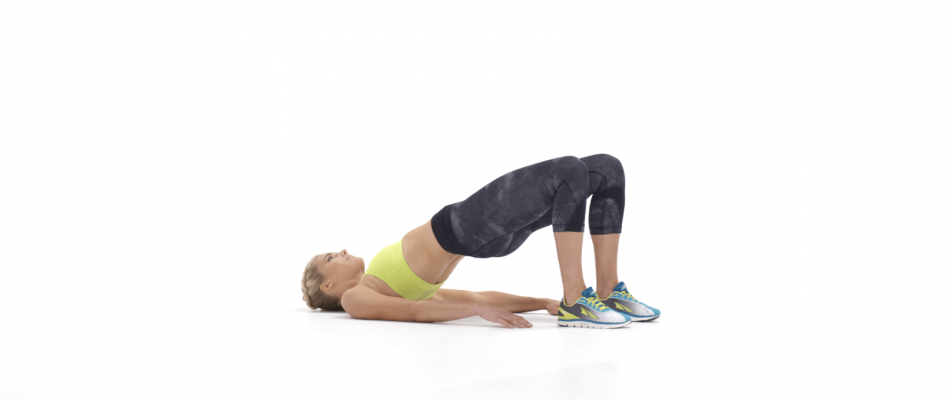
Hip raises
Hip raises are another great hip-extensor exercise. Start with your back on the floor, knees bent, so your feet are firmly planted on the floor. Press through your heels while lifting your hips up. Keep your chin tucked to avoid overextending your lower back. For an added level of difficulty, try single-leg variations or add a mini band just above your knee.
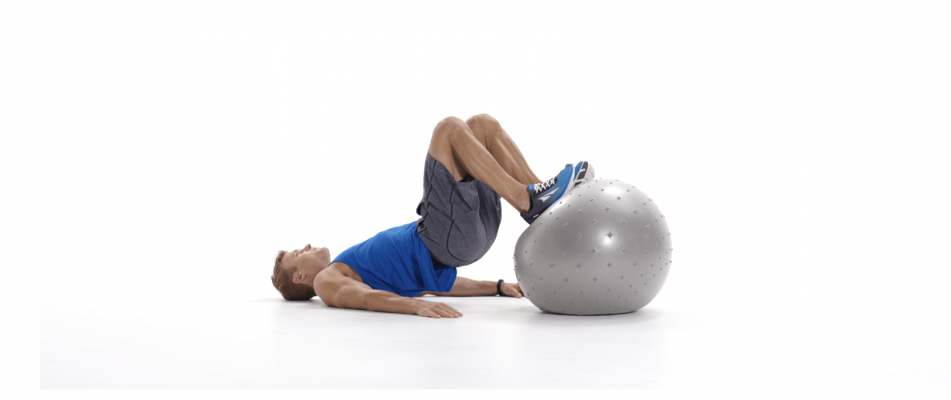
Hamstring curls
Hamstring curls are the perfect bodyweight burner to increase your hamstring strength and endurance. Lie on your back with your hips off of the ground, then place your feet on a suspension trainer, gliders, or a stability ball, pulling your heels in toward your glutes. Keep this motion controlled and increase repetitions as your endurance improves.

Lunges
Lunges are basically just an exaggerated form of running. I personally prefer walking lunges over other variations, since I’m a runner. On a track or in an open space, drop into a lunge, then lift your back foot, and take a giant step forward as you drop into another lunge. Doing this, instead of bringing your feet together in between lunges, mimics running and will increase your active hip mobility.
Core exercises
Every good runner needs a strong core—especially marathoners who run 26.2 miles. Beyond just muscular endurance, I’d recommend focusing on core exercises that encourage a good range of dynamic hip flexion. Dynamic hip mobility is a huge differentiator between elite runners and amateurs, so these exercises focus on maintaining that mobility.
- Pikes
- V-sits
- Knee-to-elbow
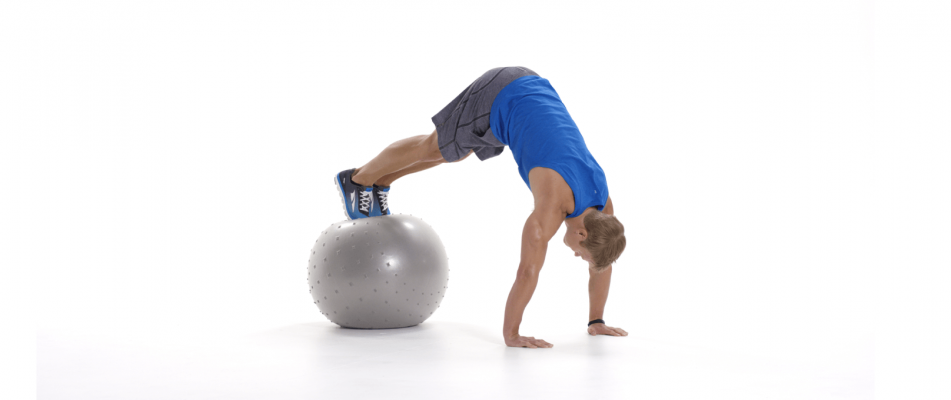
Pikes
From a plank position, place your feet on an exercise ball, gliders, or a suspension trainer. Once in the plank position, hinge at your hips, lifting your booty high while maintaining a flat back and straight legs. For an easier modification, add a bend in your knees for a tuck.
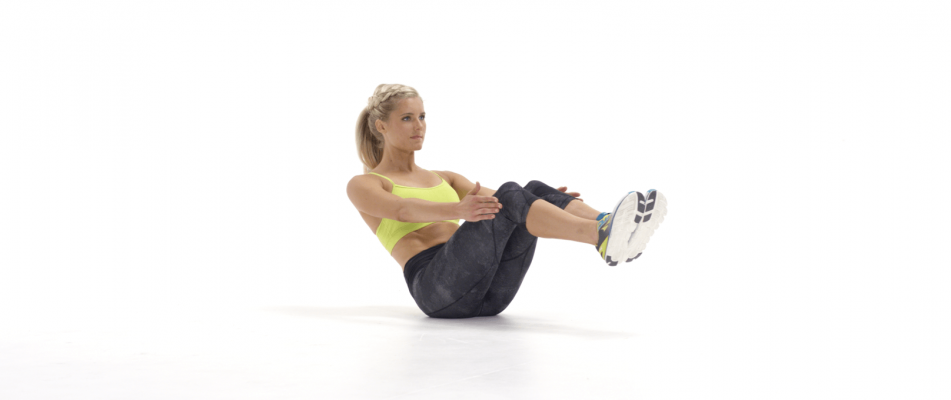
V-sit
A v-sit is one of the best isometric exercises to improve your core endurance. From a seated position, lift your feet off of the ground to balance on your sit bones. As you become stronger, work on straightening your legs more and more, as well as lowering your upper body to bring yourself to a hollow hold position.
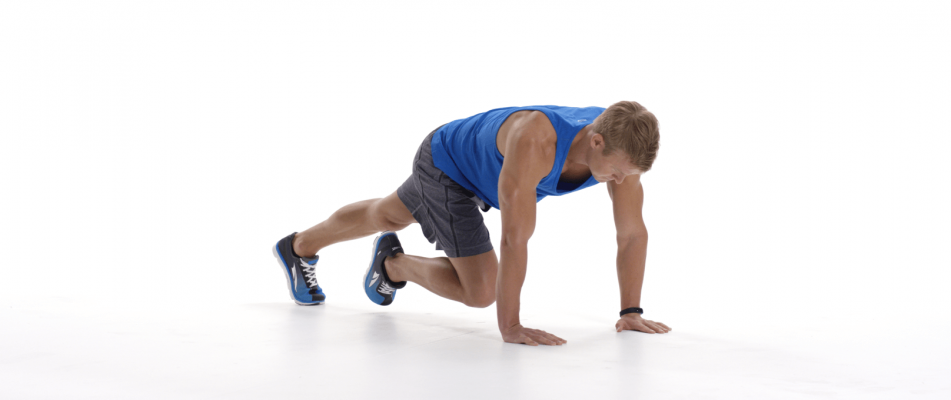
Knee-to-elbow plank
Knee-to-elbow plank is one of our favorite core exercises, because it assists in hip flexion and dynamic hip mobility. Start in a high-plank position, then pull one knee up to the same-side elbow while keeping your foot off of the ground. Hold for 10–30 seconds, then switch sides.
Shoulder and postural exercises
Arm swing is a part of running that’s sometimes overlooked, but your legs will follow where your arms lead. Good posture and strong arm drive can improve your running efficiency and greatly improve your overall performance.
- Back extensions
- Reverse flyes
- Side plank
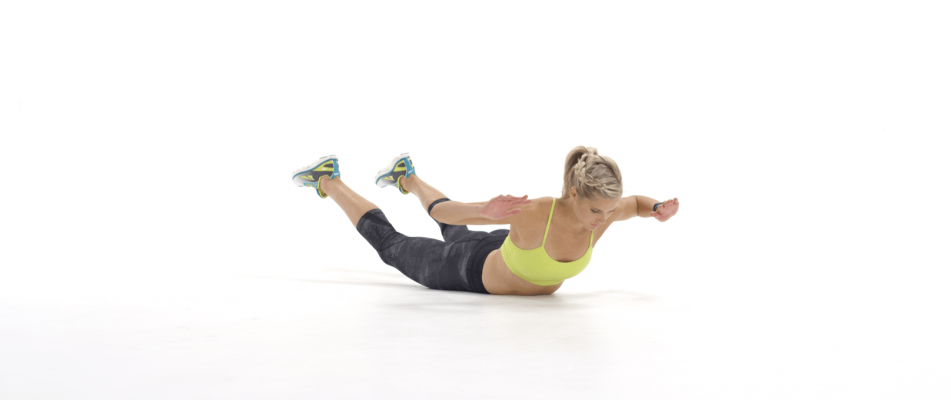
Back extensions
Your erector spinae muscles do exactly what they sound like they do: keep your spine erect. Back extensions are a great, no-equipment way to work these small, yet important muscles. Start flat on your stomach, then lift your upper and lower body off of the ground, so as little of your body is touching the ground as possible. For an added challenge, take your hands behind your head, add in flutters, or try a variation by making a “snow angel” motion.

Reverse flyes
Reverse flyes are a great way to work your rear deltoids and help open up your posture. Start in a hinged position with your back flat, then, with a moderate-to-light dumbbell in each hand, lift your arms wide to form one straight line.

Side plank
Side planks are a great way to work on shoulder endurance, as well as get in a little core work. Try forearm and straight-arm variations to see which challenges you more. Work on steadily improving how long you can hold it.
Tips and Tricks
- Lift heavier in the off-season and lighter during race season.
- You’ll want to build a strong base, but when you’re racing and upping your mileage, you don’t need more breakdown in your muscles. After all, a sore racer isn’t a fast racer.
- Move in multiple planes of motion.
- Running takes place predominantly in the sagittal plane. To improve your overall fitness, be sure to incorporate movements in different planes of motion, primarily the frontal and transverse planes. Think jumping jacks or any rotational movements.
- Listen to your body.
- If you are overly sore, you won’t be able to push as hard during your running workouts, so you might want to adjust your routine to allow for an easy run after a heavy strength-training session. That way, your body has time to recover. As you add another stressor on your body, you’ll want to be sure to not overdo it.
Hopefully, you’ll be able to incorporate a few of these movements into your next strength training workout. Stay strong and best of luck!
You might also like

Find Your Stride with Tommy Rivs in the Joy of Running Part 2: Redwoods, Workouts 1-10
There’s just something magical about taking your next step forward, especially when it means you’re surrounded by the towering redwoods and rugged beauty of California’s northern coast. iFIT Trainer Tommy Rivs’ newest series will help you experience the magic of this region with the Joy of Running Part 2: Redwoods, Workouts 1-10. This beginner-friendly program is designed to help you progress from walking to running at your own pace.Explore California’s Scenic CoastSet along breathtaking coastal trails and through scenic redwood groves, this series brings the natural beauty of Northern California to your treadmill. From the peaceful paths of Laguna Point to the rolling meadows of Mendocino Headlands, each workout is an opportunity to breathe, move, and connect with the pure joy of movement.Make Progress with Tommy RivsKnown for his thoughtful coaching and love of movement, Tommy Rivs will guide you through a mix of walking and running intervals to gradually build your endurance and confidence. Each workout keeps the speed steady while changing your movement so you can focus on how your body feels and adapts as you move.Whether you’re returning to fitness or taking your first steps toward running, this series is all about moving forward with purpose. Tommy will help you to:Develop endurance and build strength with progressive intervalsImprove your form and consistency with his expert guidanceReconnect with the joy of movement in an inspiring settingBuild confidence to take on your next running challengeThis is only the beginning; there’s so much more to come with Rivs. For now, lace up those shoes and join him for an incredible journey amongst the redwoods.Join Tommy Rivs in the Redwoods
November 3, 2025
.jpg&w=3840&q=75)
Trainer Games Complete Collection: Every Workout. Every Episode. One Epic Experience.
Experience the full intensity of Trainer Games in one place. The Trainer Games Complete Collection brings every episode, workout, and behind-the-scenes moment together inside the iFIT fitness app, so you can train, watch, and stay inspired alongside elite trainers from start to finish.
February 16, 2026

Explore Heart Rate Training with the ActivePulse™ Training Series
When it comes to a customized, interactive workout experience, it doesn’t get better than heart rate training. Our new, groundbreaking feature called ActivePulse uses your heart rate to personalize your workout. It’s the newest way to experience an interactive, personalized experience with iFIT. What is ActivePulse? ActivePulse is iFIT’s first heart rate training feature, designed for users who want to get the most out of their workouts. With ActivePulse turned on and a Bluetooth®-enabled heart rate monitor connected to your treadmill, the intensity of your workout will be automatically adjusted, based on your target heart rate zone. You will automatically be sped up or slowed down in order to maintain the ideal heart rate zone for your workout. This includes recovery, speed, or strength runs! Ready to explore ActivePulse? Try the ActivePulse Training Series! If you’re ready to try this new feature and put heart rate training to work for you, join the ActivePulse Training Series that covers all the basics of ActivePulse and heart rate training as you explore beautiful San Diego. Filmed in 2019, this six-part program is led by iFIT Trainer Tommy Rivs Puzey. Together, you’ll run through San Diego as you learn how to use the ActivePulse feature. You’ll also learn about the five heart rate zones, cardiac drift, and how your heart responds to stress. As you explore different zones, Tommy will continue to adjust your workout in order to set the perfect intensity for your fitness level. Disclaimer: This blog post is not intended to replace the advice of a medical professional. The above information should not be used to diagnose, treat, or prevent any disease or medical condition. Please consult your doctor before making any changes to your diet, sleep methods, daily activity, or fitness routine. iFIT assumes no responsibility for any personal injury or damage sustained by any recommendations, opinions, or advice given in this article. Always follow the safety precautions included in the owner’s manual of your fitness equipment.
March 30, 2021